Choosing the upper is choosing how the boot will age
When footwear makers plan a new safety boot, most of the discussion goes to toe caps, midsoles and outsoles. The upper leather gets less attention, yet it decides how the boot looks after three months on site, how easy it is to clean, how it copes with water and how it feels during a long shift. It is also one of the largest material costs in the shoe.
Three upper leathers come up in almost every work and safety footwear programme: Barton print, nubuck and smooth full-grain. This guide compares them side by side so product developers and sourcing teams can match the leather to the wearer's working environment rather than choosing from a swatch card on looks alone.
The three leathers in brief
Barton print leather
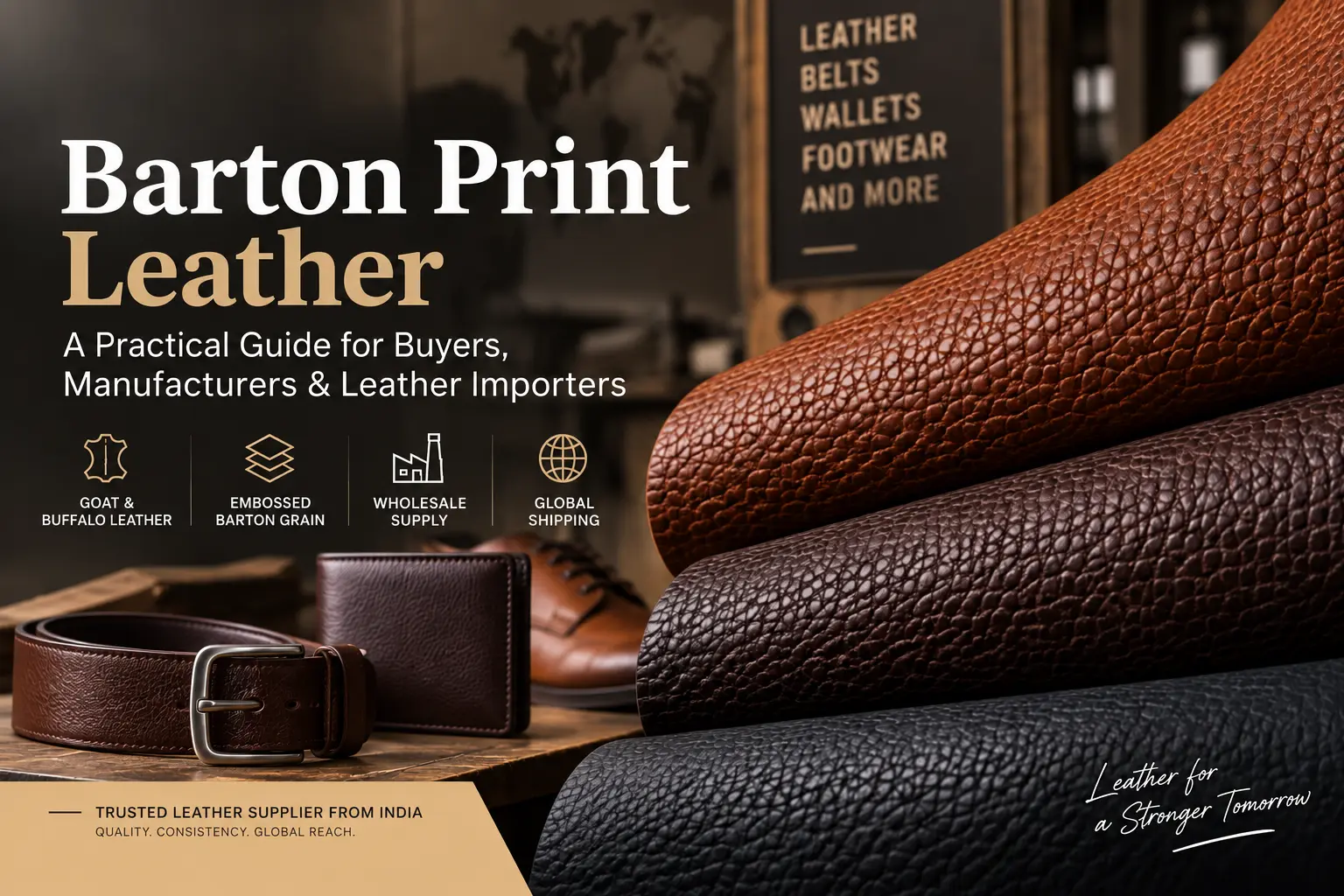
Barton print is leather with an embossed, cross-hatched or pebbled pattern pressed into a finished surface, usually over a buffed or corrected grain and sealed with a pigmented finish. Buffalo hides are widely used for it in India. Because the pattern and finish create the surface, hides with minor natural marks can still produce a clean, uniform look.
Nubuck
Nubuck is grain leather whose outer surface has been lightly sanded to raise a fine, velvety nap. It keeps much of the strength of the grain layer, feels soft, and is often treated with water-repellent agents for outdoor and work boots. Its open surface shows marks, oil and stains more readily than a sealed finish.
Smooth full-grain
Full-grain leather keeps the original grain surface with minimal correction. It can be finished as aniline, semi-aniline, lightly pigmented or oil-rich (often called oil pull-up). Because nothing hides the surface, it needs well-selected hides, and that selection shows in the price.
Side-by-side comparison
| Factor | Barton print | Nubuck | Smooth full-grain |
|---|---|---|---|
| Surface | Embossed pattern under a sealed, usually pigmented finish | Sanded grain with a soft nap | Natural grain, lightly finished |
| Hide selection needed | Moderate; the print helps mask minor surface marks | High; sanding does not hide defects well | Highest; every mark is visible |
| Look across a large order | Very uniform | Some natural shade variation | Most variation; natural character |
| Scuff and scratch masking | Good; texture hides light scuffs | Fair; scuffs can be brushed but show on light colours | Lower on smooth finishes; oil pull-up can be rubbed back |
| Cleaning | Easy; wipe clean | Harder; needs brushing and suitable cleaners | Easy to moderate, depending on finish |
| Water resistance | Depends on the finish and any water-repellent treatment | Good when hydrophobic treatment is specified; poor without it | Depends on tannage and treatment |
| Breathability | Can drop if the finish coat is heavy | Generally good | Generally good with lighter finishes |
| Typical feel | Firm, structured | Soft, supple | Ranges from firm to supple |
| Typical use | Industrial and general safety shoes, high-volume programmes | Outdoor-style work boots, logistics, hiker-style safety shoes | Premium work boots, executive and light-industry safety shoes |
These are general tendencies. The tannery's process and the finish recipe matter as much as the leather type, so every claim above should be confirmed on samples from your actual supplier.
Barton print: strengths and watch-outs
Barton print is popular in industrial safety footwear because it is practical. The texture hides the light scuffs that build up in warehouses, factories and on construction sites, and the sealed finish can be wiped clean. For brands running large orders across many sizes and repeat batches, the printed surface gives a consistent look from boot to boot and from order to order.
It also tends to improve cutting yield. Hides with small surface marks that would be rejected for smooth full-grain can often be used, which helps keep material costs predictable.
Things to watch:
- Finish adhesion and flex: the finish carries the look, so poor adhesion shows up as cracking or peeling at the toe flex line. Ask for flex and finish-adhesion data and do your own lasting trials.
- Breathability: heavy pigment coats can make a boot feel warm. If comfort over long shifts matters, ask about water vapour permeability.
- Print depth and definition: shallow or uneven embossing looks cheap and can wash out where the leather is stretched over the toe.
- Loose grain: a print can hide surface marks but not a weak structure. Check for wrinkling ("pipey" grain) when the leather is bent grain-side in.
Nubuck: strengths and watch-outs
Nubuck gives a soft, premium outdoor look and good comfort. When it is treated to be water-repellent, it suits wet environments and outdoor-style safety boots. Many wearers find it breaks in quickly.
Things to watch:
- Staining: oil, grease and some chemicals can mark nubuck permanently. It is a weaker choice for oily workshops or kitchens unless the treatment is designed for that.
- Water-repellent claims: ask how water resistance was tested and on which lot. Treatments vary widely between suppliers.
- Shade and nap consistency: sanding and dyeing give some variation, so approve against physical standards, not photos.
- Care: end users need to brush and re-proof nubuck. That is fine for some markets and a source of complaints in others.
Smooth full-grain: strengths and watch-outs
Smooth full-grain keeps the hide's strongest layer intact and generally breathes well. It looks premium, polishes or conditions well, and can be finished in many ways, including oil-rich finishes that let light scratches be rubbed back. It is a natural choice for higher-priced work boots and smarter safety shoes worn in offices, labs or on site visits.
Things to watch:
- Cost and yield: the hide selection needed for a clean smooth surface raises material cost and lowers yield.
- Visible damage: deep scratches and scuffs stand out on smooth finishes, which matters in abrasive environments.
- Batch variation: natural character means more variation between hides and batches, so agree acceptance limits up front.
Matching the leather to the workplace
| Working environment | Often a good fit | Why |
|---|---|---|
| Heavy industry, warehouses, general manufacturing | Barton print | Hides scuffs, wipes clean, consistent across large orders |
| Construction and outdoor sites | Water-repellent nubuck or Barton print with a water-resistant finish | Copes with rain and mud; choose based on look and care expectations |
| Oily or greasy workshops | Sealed Barton print or smooth full-grain | Sealed surfaces resist staining better than an open nap |
| Food processing and wet cleaning | Sealed finishes with suitable water resistance | Easier to wash and sanitise; check compatibility with cleaning agents |
| Supervisors, engineers, light industry | Smooth full-grain | Smarter appearance, comfort, good with care |
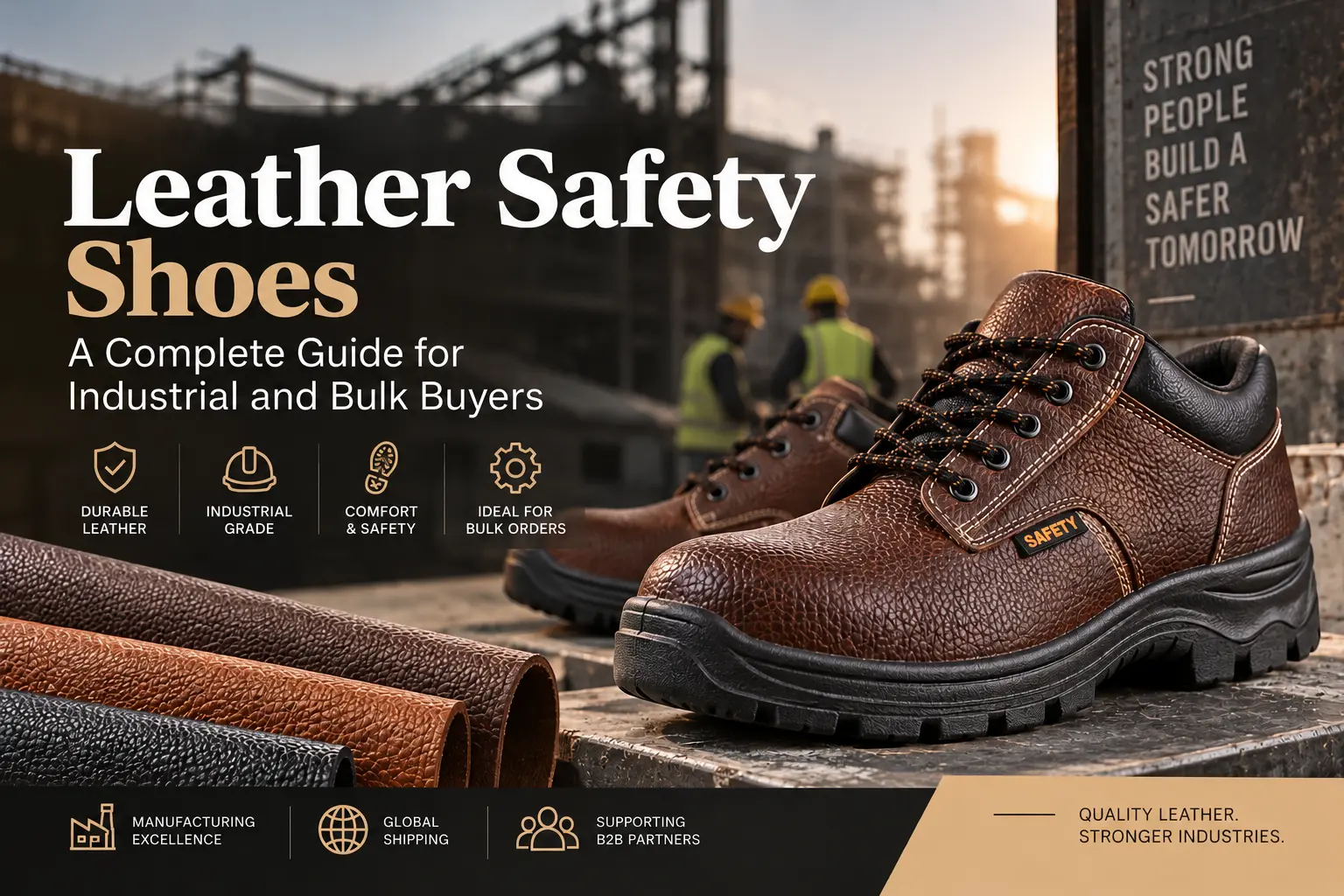
Remember that the boot, not the leather, is what gets certified. Standards such as EN ISO 20345 or ASTM F2413 apply to the finished footwear. The upper material has to perform within the boot's construction, so test the leather in your own build before committing. Our leather safety shoes guide covers the boot-level features bulk buyers check.
How to run a fair comparison
- Request swatches of all three options in the same thickness range and colour family.
- Ask each supplier for recent test reports on the actual article, covering at least tear strength, flex resistance, finish adhesion (for finished leathers), water behaviour and restricted substances such as hexavalent chromium.
- Make a small set of pre-production boots in each leather on your own last and construction.
- Run a wear trial with real workers in the target environment for several weeks and collect feedback on comfort, appearance and cleaning.
- Compare cost on a per-pair basis, including cutting yield, not just price per square foot.
Next steps
If you are developing or re-sourcing a safety footwear line, side-by-side samples are the quickest way to decide. UT Leather and Allied Products in Kanpur supplies buffalo Barton print leather by the square foot and offers other buffalo upper finishes for work and safety footwear; details are on our Barton print leather page and our leather for safety shoes page. For background on the material itself, see our practical guide to Barton print leather. To compare options for your own construction, you can request swatches or a quote at https://urbantuck.com/contact.
Frequently asked questions
Is Barton print leather good for safety shoes?
Yes, for many industrial uses. Its embossed, sealed surface hides light scuffs, wipes clean and looks consistent across large orders. Check finish adhesion, flex resistance and breathability on samples, because the finish carries much of its performance.
What is the difference between Barton print leather and nubuck?
Barton print has an embossed pattern under a sealed finish, while nubuck is grain leather sanded to a soft nap. Barton print is easier to clean and more uniform; nubuck is softer and often more breathable but stains more easily.
Is full-grain leather better than Barton print for work boots?
Not automatically. Smooth full-grain keeps the strongest grain layer and looks premium, but it costs more and shows scuffs. Barton print can be the more practical choice for abrasive, high-volume industrial use.
Which upper leather is best for wet working conditions?
A leather with a tested water-repellent treatment, either nubuck or a finished leather such as Barton print. Ask how water resistance was tested and on which lot, and confirm it in your finished boot.